The core difference lies in how molten aluminum is forced into the mold: high-pressure die casting (HPDC) uses 10–175 MPa of injection pressure to fill the cavity in milliseconds, while low-pressure die casting (LPDC) relies on 0.02–0.1 MPa of controlled gas pressure, and gravity die casting (GDC) uses no external pressure at all — only the weight of the metal. These differences in process fundamentals cascade into distinct outcomes for speed, part complexity, mechanical properties, and cost.
Understanding the physical mechanics explains why each method suits different applications.
Molten aluminum is injected into a hardened steel die at speeds of 30–100 m/s by a hydraulic piston. The metal fills the cavity in 10–100 milliseconds and solidifies under sustained pressure. Two variants exist: hot-chamber (for low-melting-point alloys) and cold-chamber (standard for aluminum). Cycle times run as fast as 15–60 seconds per part.
A sealed furnace sits below the die. Pressurized gas (typically 0.02–0.1 MPa) pushes metal up through a riser tube into the mold cavity. The slow, controlled fill minimizes turbulence, resulting in low gas porosity and excellent internal soundness. Cycle times are longer — typically 3–8 minutes per part.
Also called permanent mold casting, GDC pours molten aluminum by gravity directly into a reusable metal mold with no applied pressure. Fill is slow and gentle, making the process ideal for thick-walled, structurally critical parts. It's the simplest setup, with tooling costs 30–50% lower than HPDC for comparable part sizes.
The table below captures the most decision-relevant metrics across all three methods.
| Parameter | High-Pressure (HPDC) | Low-Pressure (LPDC) | Gravity (GDC) |
|---|---|---|---|
| Injection Pressure | 10–175 MPa | 0.02–0.1 MPa | None (gravity only) |
| Cycle Time | 15–60 sec | 3–8 min | 3–10 min |
| Minimum Wall Thickness | 0.5–1.0 mm | 2–3 mm | 3–5 mm |
| Surface Finish (Ra) | 0.8–1.6 μm | 1.6–3.2 μm | 3.2–6.3 μm |
| Porosity Level | Higher (gas entrapment) | Low | Low–Medium |
| Weldability / Heat Treatment | Limited (porosity) | Yes | Yes |
| Tooling Cost (relative) | High ($50K–$250K+) | Medium | Lowest |
| Optimal Production Volume | 50,000–1M+ parts | 5,000–100,000 parts | 500–50,000 parts |
| Dimensional Tolerance (IT grade) | IT8–IT10 | IT10–IT12 | IT12–IT14 |
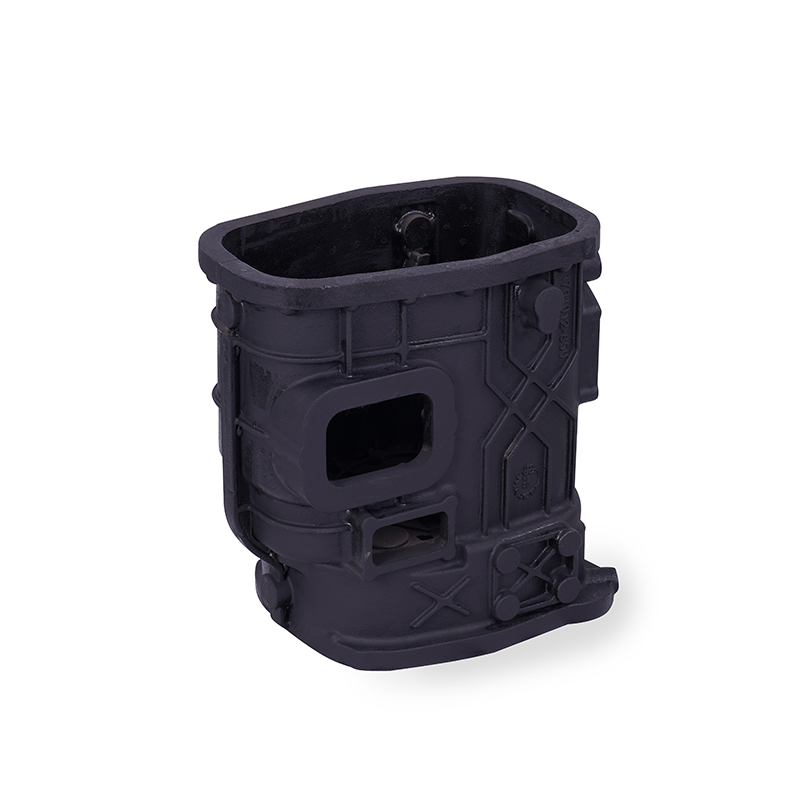
HPDC's high injection velocity enables it to fill intricate cavities with wall thicknesses as thin as 0.5 mm — a capability unmatched by the other two methods. Automotive transmission housings, EV battery trays, and smartphone frames all rely on this ability to produce thin, complex geometries at scale.
LPDC is preferred where complexity is moderate but internal integrity is critical. Automotive aluminum wheels — one of the highest-volume LPDC applications — require the low porosity and consistent microstructure that the controlled fill rate provides, combined with walls that are generally 3 mm or thicker.
GDC handles the thickest cross-sections well. Engine cylinder heads and intake manifolds are common GDC parts, where wall thicknesses of 5–10 mm are normal and the slower solidification actually aids grain structure and machinability.
HPDC parts have fine grain structures near the surface due to rapid solidification, yielding good tensile strength — typically 240–310 MPa UTS for common alloys like A380. However, internal gas porosity from the turbulent fill limits ductility and makes heat treatment risky (blisters can form).
LPDC and GDC both allow T6 heat treatment (solution heat treat + artificial aging), pushing tensile strength to 280–330 MPa with elongations of 5–12% in alloys like A356-T6. This makes them the preferred route for structurally loaded parts in suspension systems, steering knuckles, and aerospace brackets.
| Process | Common Alloy | UTS (MPa) | Yield Strength (MPa) | Elongation (%) |
|---|---|---|---|---|
| HPDC | A380 | 240–310 | 160–170 | 1–3.5 |
| LPDC (T6) | A356-T6 | 280–310 | 200–240 | 6–12 |
| GDC (T6) | A356-T6 | 275–310 | 195–235 | 5–10 |
HPDC tooling is expensive — a production die for a mid-complexity automotive part typically costs $80,000–$200,000 and is rated for 100,000–500,000 shots. That upfront cost only makes economic sense when amortized across high volumes. At 500,000 parts, the tooling cost per part drops to as little as $0.16–$0.40.
GDC molds, often made from cast iron or mild steel, cost 30–50% less than equivalent HPDC dies and are well-suited to prototypes or low-volume production runs of 500–10,000 parts. LPDC tooling falls in between, typically $30,000–$100,000, justified by the wheel and structural component industries that run batches of 20,000–80,000 per year.
Each method has carved out a distinct application niche based on these trade-offs.
The decision framework is straightforward once the application requirements are defined:
Vacuum-assisted HPDC is increasingly bridging the gap — by evacuating the die cavity before injection, gas porosity drops significantly, enabling T5 or T6 treatment on high-pressure cast parts. This variant is now widely used in structural automotive components like shock towers and body-in-white nodes, where both thin walls and heat treatability are needed simultaneously.




 русский
 日本語
日本語